In Russia, in the pre-revolutionary era, there was a meeting between Paul Dukes and an enigmatic individual who was called Prince Ozay. Paul Dukes had been experiencing the Lord’s Prayer for certain healings, which grabbed the interest of that individual. He asked Dukes to recite it, and after a while, he mentioned to him that he should say it in another way, that it should involve breathing. The prayer was to be sung “on one breath.”1. The individual turned out to be, according to the testimonies of the time, G.I. Gurdjieff.
Gurdjieff referred on many occasions to prayers. An interesting writing on the Lord’s Prayer, A Recapitulation of the Lord’s Prayer2 includes one of Gurdjieff’s mentions of prayers and the way they should be said: “Most ancient prayers have nothing in common with petitions; they are, as it were, ‘recapitulations’. By repeating them aloud or to himself, a man endeavours to experience what is in them – their content – with his mind and feeling, concentrating and reflecting on the real sense of each word – what it really means to him, how he can understand it. In this way, many ideas will become connected in his thinking and many thoughts relating to the words of the prayer will pass through his mind. And then it is precisely these thoughts which can do for him what he asks God to do.”
This writing by an anonymous author takes a deep approach to the “Lord’s Prayer”, combining perspectives from various spiritual traditions. It includes, in particular, the triad structure of the “Lord’s Prayer” presented by P.D. Ouspensky in his book “The Fourth Way”.3. Here, the Lord’s Prayer ends with a doxology – “For Thine is the Kingdom, and the Power, and the Glory, Forever. Amen.” – This doxology shows up in the first centuries of Christianity in several texts such as the Didache and some Byzantine manuscripts. The first English version of the Bible (King James) includes it in Matthew 6:13. The structure of the Lord’s Prayer would be made up of three triads, an invocation and a final blessing.
The scheme is as follows:
Invocation: Our Father which art in Heaven
First Triad:
- Hallowed be Thy Name
- Thy kingdom Come
- Thy will be done in earth, as in Heaven
Second Triad
- Give us this day our daily bread
- And forgive us our debts as we forgive our debtors.
- And lead us not into temptation, but deliver us from evil
Third Triad (Doxology)
- For Thine is the Kingdom
- And the Power
- And the Glory
Blessing: Forever. Amen.
In this structure, the number 3 of the second triad brings together two elements of the Lord’s Prayer: “And lead us not into temptation” joins with “but deliver us from evil.”
This idea of the triads suggests the presence of the law of three in the Lord’s Prayer: in each triad there would be three forces, the Active Force, the Passive Force, and the Conciliatory Force. On the other hand, the sequence of the Lord’s Prayer gives an account of a process that goes from the highest and the finest (Father … heaven) to the lowest, the heaviest (evil). That is, it represents an involutive sequence from the point of view of the law of seven. The law of seven expressed by the octave of musical notes has two dynamics, one evolutionary, upwards (do-re-mi-fa-sol-la-si-do) and the other involutive, downwards (do-si-la-sol-fa-mi-re-do). When we put together the law of three and the law of seven, we find the enneagram, a symbol introduced in the West by Gurdjieff. A circle divided into 9 points, an inner equilateral triangle that joins points 3, 6 and 9 and a broken or hexagonal line that connects the points or notes of the octave.
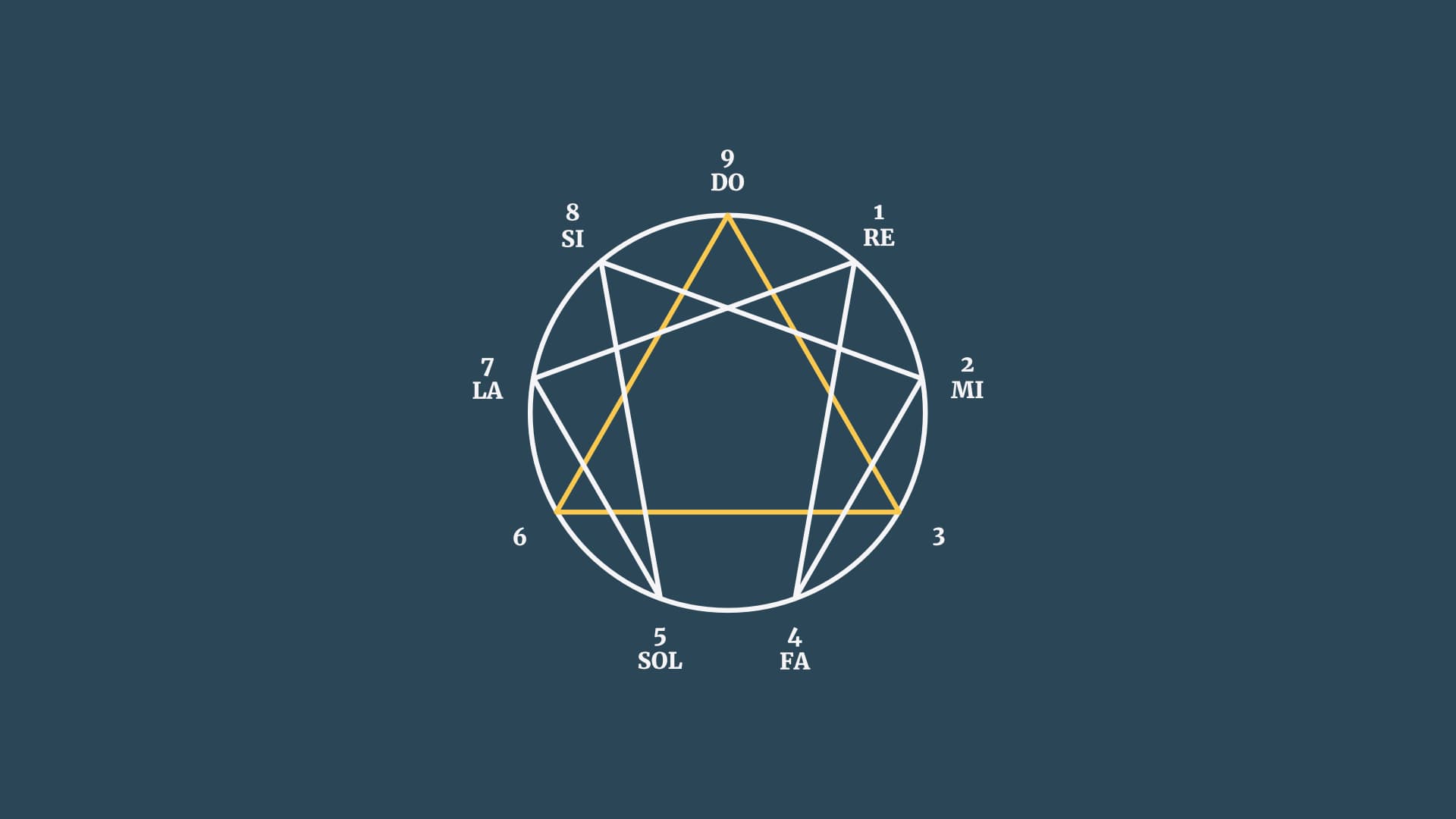
The enneagram is the representation of the laws of creation and maintenance of the world, of the law of three and the law of seven, of the law of creation of all things, and the law that governs all processes. And as Michel Conge4 points out:
“The enneagram represents every phenomenon, every living being, every functioning.
But above all it is the ABSOLUTE. It is the only acceptable image of God. He is the visible and invisible Lord, the Creator and the One who keeps all creation alive.”
To present the “Lord’s Prayer” in the enneagram is therefore quite seamless.
Vicente’s Enneagram
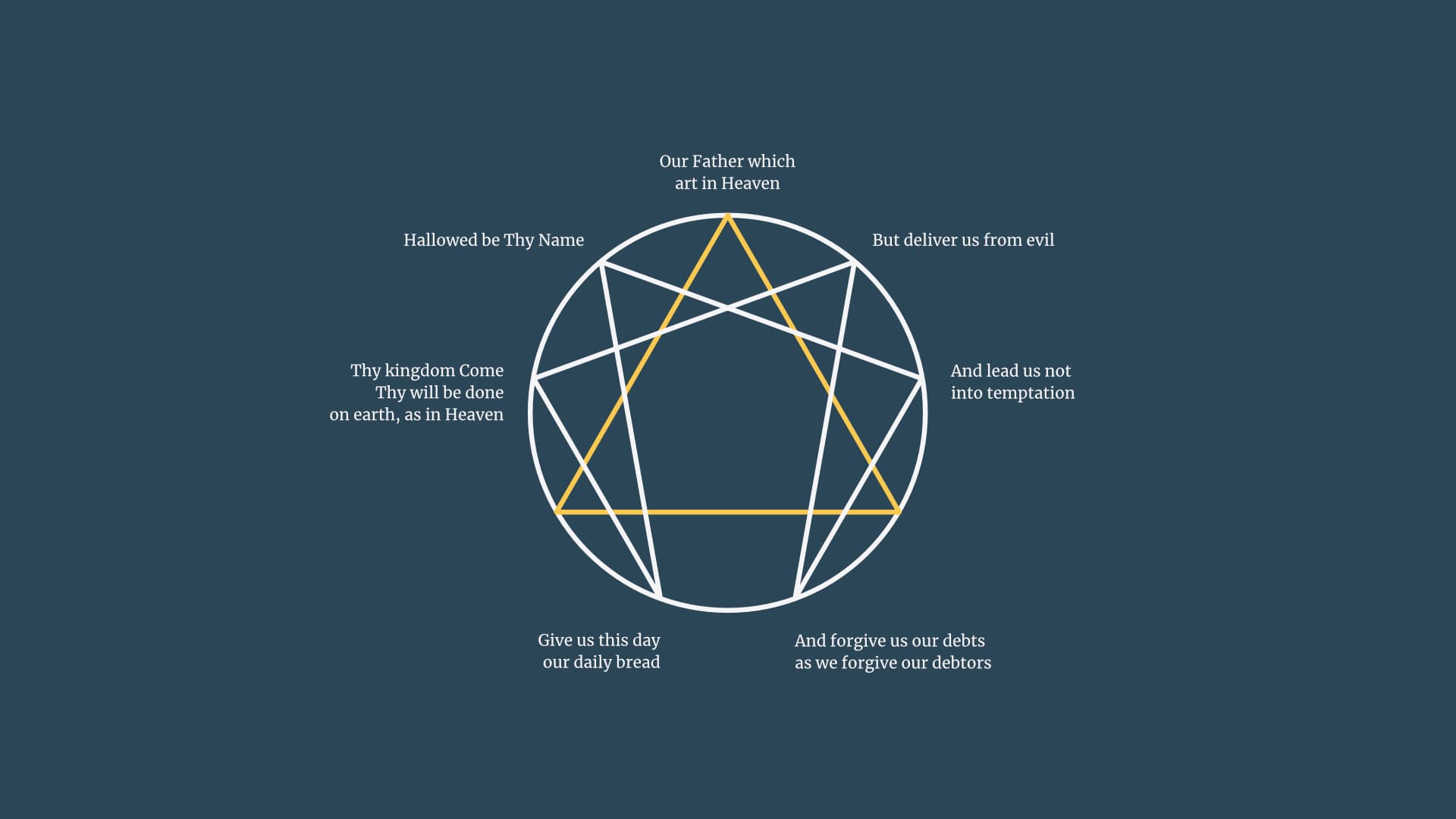
The first visualized enneagram of the “Our Father” was one that Vicente Valentini showed us on one occasion. It was probably worked on by the Gurdjieff groups of Venezuela. This enneagram places the “Lord’s Prayer” on the octave of the enneagram, leaving points 3 and 6 free. Point 7 of the Enneagram contains the phrases of the prayer: “Thy kingdom come” and “Thy will be done on earth as in Heaven.”
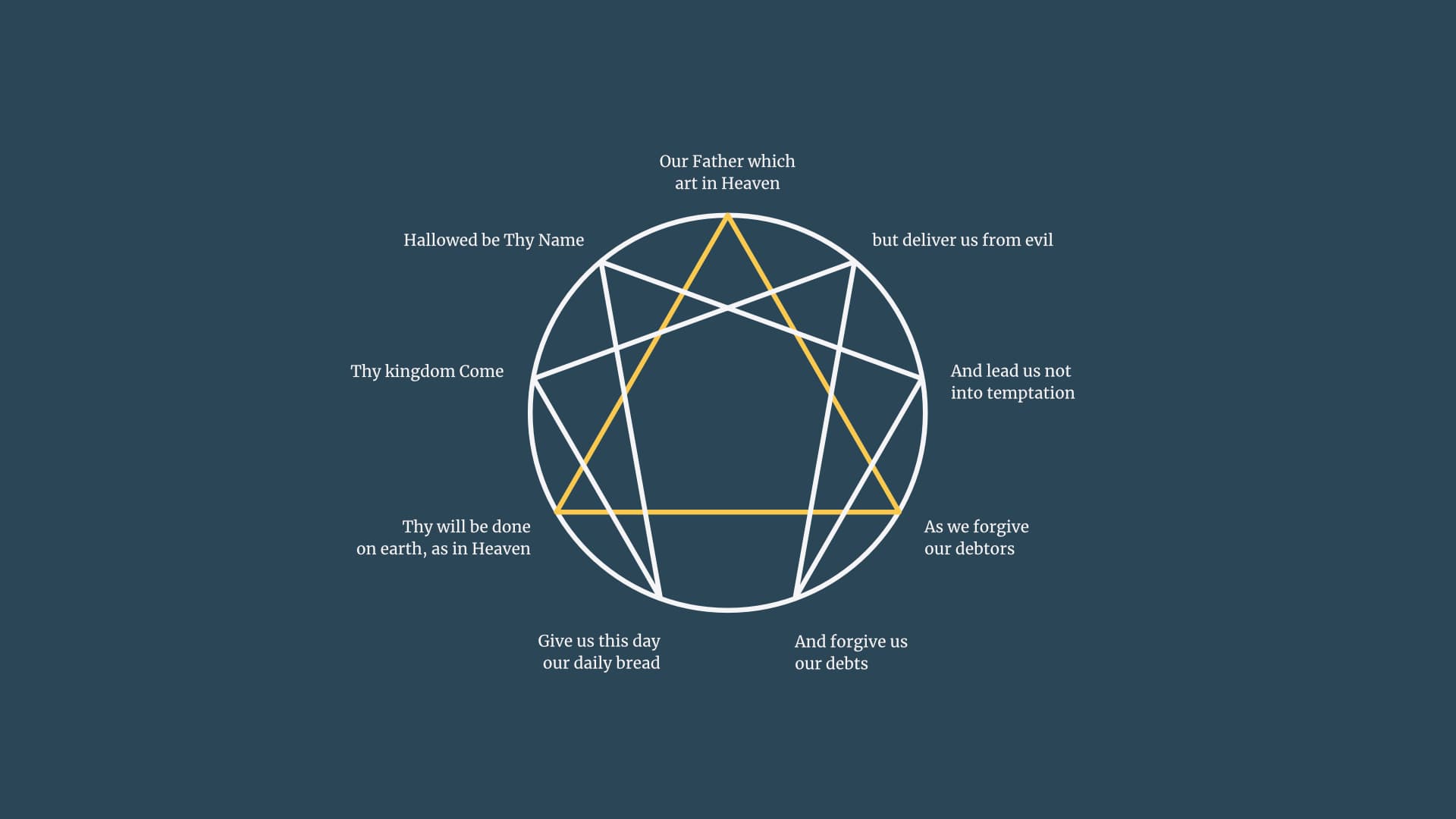
The 9 clauses enneagram
Another possibility to present the “Lord’s Prayer” in the enneagram refers to the clauses that appear in the prayer (according to the verbs: art, be, come, be done, give, forgive, forgive, lead, deliver). There are 9 clauses that could fill each one of the enneagram points. The phrase ” And forgive us our debts as we forgive our debtors ” is divided into two: one part at point 4 and the other at point 3 of the enneagram. It is interesting to look at the meaning of what is found in points 3 and 6. At point 3 there is a necessary shock to move from the note f to the note mi (there is a semitone between mi and fa). So the sentence “as we forgive our debtors “, is like the will of us, human beings. The will of the Father is shown in point 6. This forms the inner triangle of the Enneagram: the Father; the Father’s will; our will.
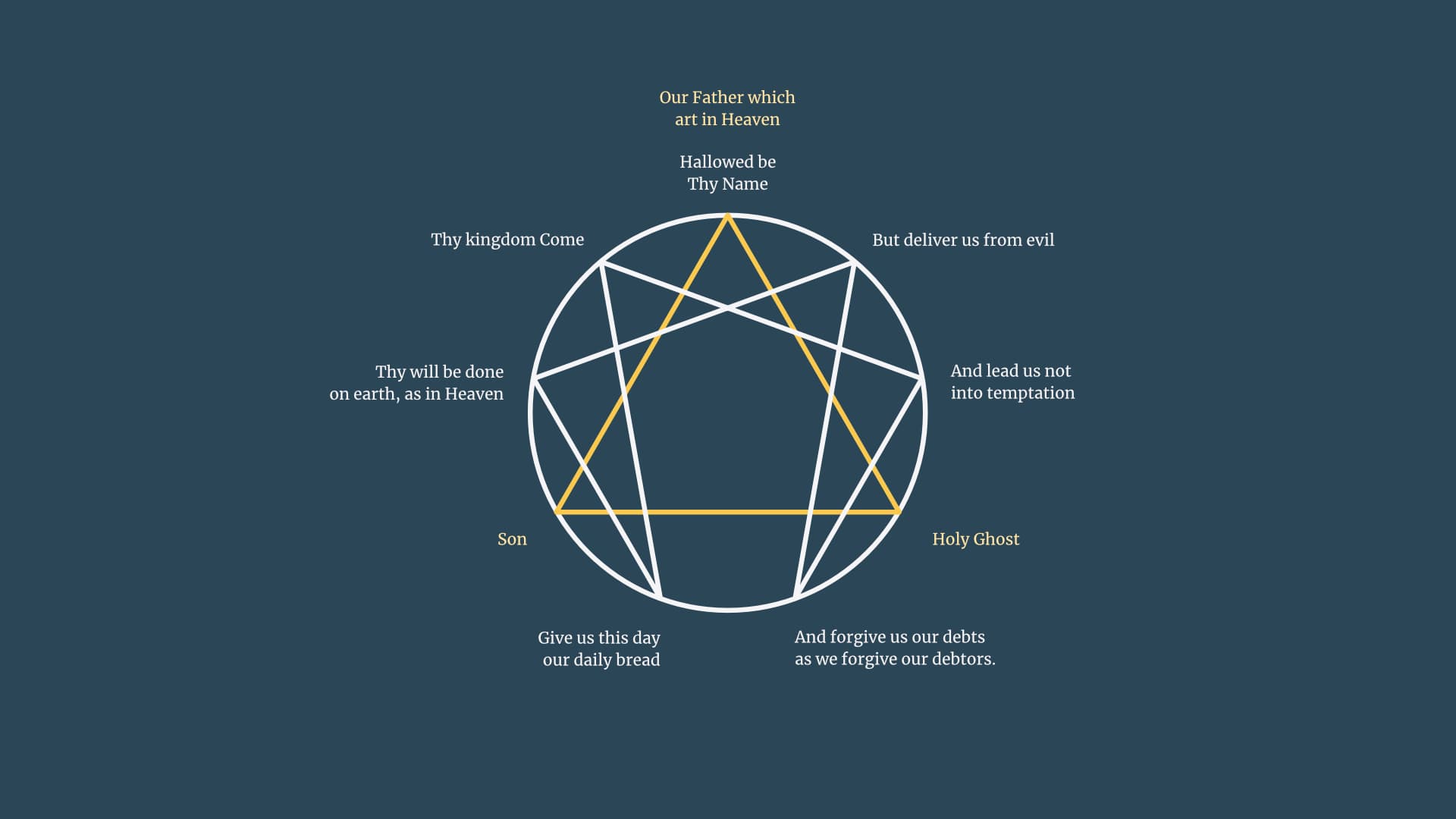
The 7 petitions enneagram
In the writing Simple Method of Prayer for a Good Friend 5, Martin Luther presents to his friend Peter, the barber, the “Lord’s Prayer” recommending “that prayer be our first task in the morning, early, and the last in the evening” and that he would do it by saying: “In the name of my Lord Jesus Christ I raise my prayer to you in union with all the Christian saints of the earth, how he has taught me: ‘Our Father, who art in heaven, etc.’ and so on until the end word for word” and also he asks him to repeat one by one the seven petitions that make up the prayer, the first being: “Hallowed be Thy Name”. Thus, the Lord’s Prayer is made up of an invocation and seven petitions. These seven petitions can be placed perfectly on the seven points of the octave. Points 3 and 6 are free, so the inner triangle can be completed by referring to the triune God, to the Trinity: Father, Son, Holy Ghost.
This is as far as we get with this first approach to the Lord’s Prayer and the enneagram. From here on, all stands in each one’s search; try to prevent the mind from rushing to construct interpretations and draw quick conclusions. May these enneagrams produce impressions, nourishment for being. Later, the time will come for the mind to do its work and question, analyze, imagine other possibilities.
In the meantime, let the Lord’s Prayer resound in each one…
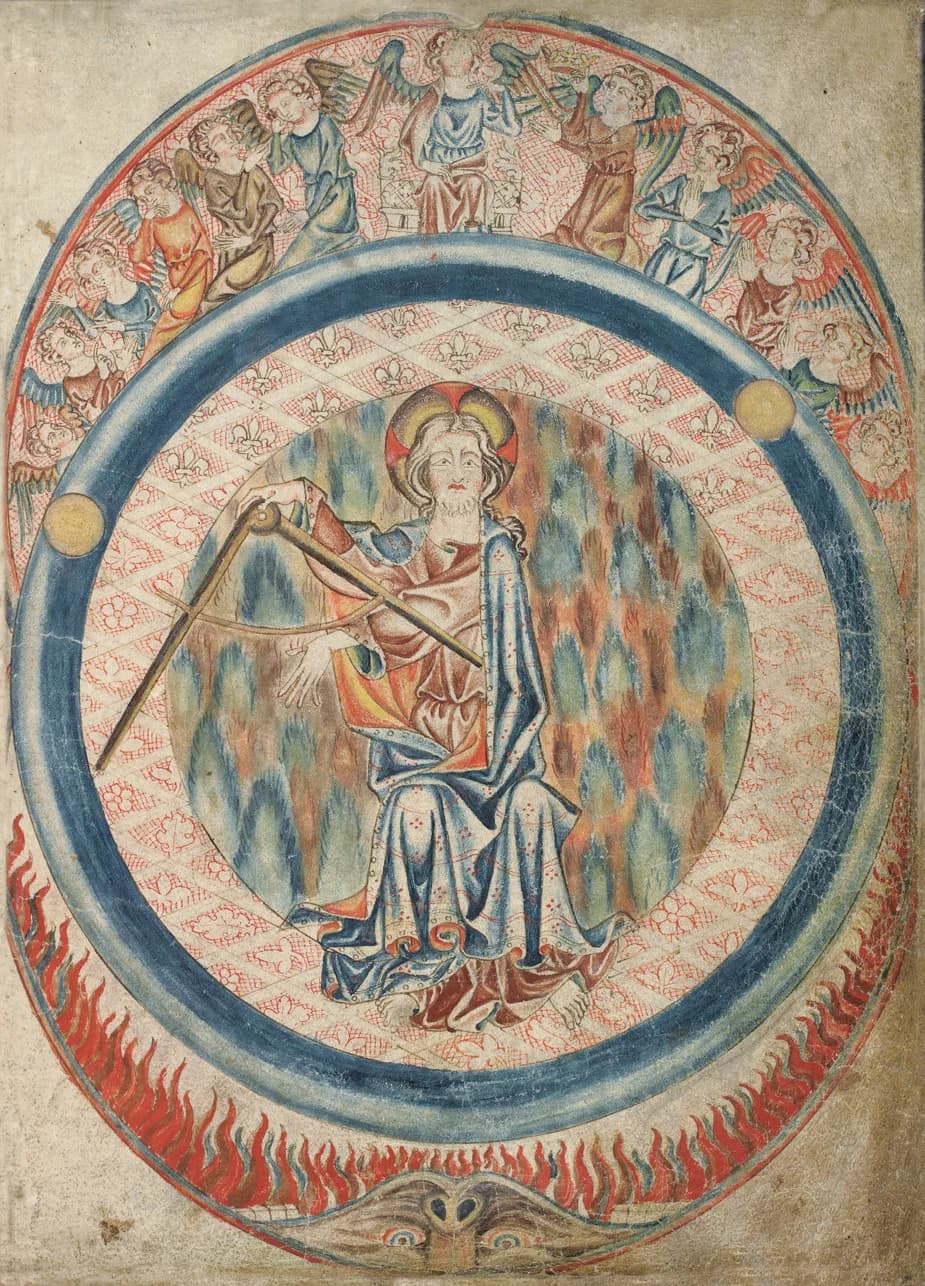
Image portada: The Holkham Bible Picture Book (ca. 1330)
- Sir Paul Dukes, De un solo aliento, Ganesha, 1998 ↩︎
- Anonymous, “A recapitulation on the Lord’s Prayer”, Eureka Editions, 2021 ↩︎
- P.D. Ouspensky, “El Cuarto Camino”, KIER, 2000 ↩︎
- “Búsqueda de Michel Conge sobre el eneagrama”, Edición privada ↩︎
- Martín Lutero, “El Magnificat seguido de Método Sencillo de Oración”, Colección Ichthys, Ediciones Sígueme, 2017 ↩︎