Poetry explores the deepest corners of the self, seeking to find and name those intimate experiences that sometimes—if not always—prove ineffable. Through poetry, the spirit finds a space to express its longings, doubts, fears, and revelations, going beyond the everyday experience, beyond the ordinary mind, as Buddhists would say, to connect with something greater or deeper than the self and in some way, touch our ultimate essence. In many cases, as in the four poems by contemporary writers included here, the word—which is not the experience itself but points to it—builds a bridge going deeper and letting us access moments of spiritual contemplation. As is well known, many great teachers from various spiritual traditions have expressed their insights—if they can be called that—through songs and poems that, by touching our most sensitive parts, allow us to see the invisible visible.
Presentation and traductions by Miriam Cotes Benítez

Dorothy Hunt
Dorothy Hunt is a writer, poet, and spiritual teacher born in the United States. The traditions in which she has trained are Zen and Advaita Vedanta. Dorothy teaches about consciousness, presence, and non-duality, and her poetry reflects her deep exploration in these fields.
Peace is this Moment without Judgment
Do you think peace requires an end to war?
Or tigers eating only vegetables?
Does peace require an absence from
your boss, your spouse, yourself?
Do you think peace will come some other place than here?
Some other time than now?
In some other heart than yours?
Peace is this moment without judgment.
That is all. This moment in the Heart-space
where everything that is is welcome.
Peace is this moment without thinking
that it should be some other way.
that you should feel some other thing,
that your life should unfold according to your plans.
Peace is this moment without judgment,
this moment in the Heart-space where
everything that is is welcome.
Mary Oliver
Mary Oliver (1935–2019) was an American poet known for her poetry inspired by nature and everyday life. She won the Pulitzer Prize and the National Book Award. Her meditative style made her one of the most read poets in the United States.
I Worried
I worried a lot. Will the garden grow, will the rivers
flow in the right direction, will the earth turn
as it was taught, and if not how shall
I correct it?
Was I right, was I wrong, will I be forgiven,
can I do better?
Will I ever be able to sing, even the sparrows
can do it and I am, well,
hopeless.
Is my eyesight fading or am I just imagining it,
am I going to get rheumatism,
lockjaw, dementia?
Finally, I saw that worrying had come to nothing.
And gave it up. And took my old body
and went out into the morning,
and sang.
Kaveri Patel
Kaveri Patel resides in the United States. She is known as a poet and writer of texts on meditation and mindfulness. Her poetry explores themes of self-compassion and connection with the present moment.
Thanking a Monkey
There’s a monkey in my mind
swinging on a trapeze,
reaching back to the past
or leaning into the future,
never standing still.
Sometimes I want to kill
that monkey, shoot it square
between the eyes so I won’t
have to think anymore
or feel the pain of worry.
But today I thanked her
and she jumped down
straight into my lap,
trapeze still swinging
as we sat still.
Mark Nepo
Mark Nepo is an American poet, philosopher, and spiritual teacher. In his poems, he writes about life, resilience, and spirituality. His books have inspired many people on their journey of self-discovery and spiritual seeking.
Below our strangeness
My soul tells me, we were
all broken from the same nameless heart,
and every living thing
wakes with a piece of that original
heart aching its way into blossom.
This is why we know each other
below our strangeness, why when
we fall, we lift each other, or when
in pain, we hold each other, why
when sudden with joy, we dance
together. Life is the many pieces
of that great heart loving itself
back together.
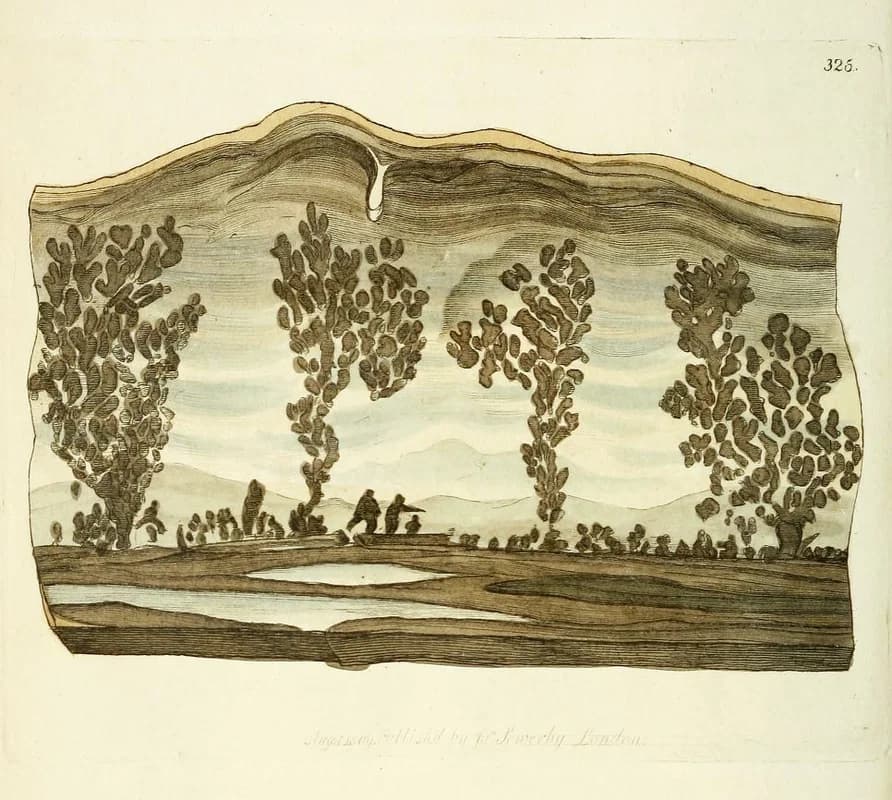
Image: Cotham Marble — “The fanciful figure to themselves in this something like a boat and men in one part, and hedge-rows in another, with trees in full foliage.” James Sowerby’s British Mineralogy (1802–17)