René Daumal was born in Boulzicourt, Ardennes, France, on March 16, 1908. The question that comes to my mind, which I leave unanswered, is: how was Daumal carved out? A generous and visionary poet, an essentialist, brave, generous in his giving, willing to tear the veil of reality to touch the essence of being and share his emotion with us—how was he created? What life circumstances, landscapes, influences from ancestors, father, mother, friends, poets, artistic and mystical movements, education, childhood and adolescence, lived history, and sufferings shaped this poet of truth? What experiences gave him that inner strength to be?
*
Biographical details undoubtedly draw our attention to his outward appearance and paint a picture of him, offering us a profile, a valuable portrait. However, that life—rich both inwardly and outwardly—also moves me, and especially so, through those inner stirrings expressed from the depths of genuine feeling. How can we confront Daumal’s very questions and allow ourselves to be touched by his inquiry and his sense of emptiness?
*
There are numerous scholarly works that provide a thorough and in-depth account of Daumal’s life and work. One of them is Carlos Rocha’s La Vida y Obra de René Daumal1, a meticulous and wonderful study:
“Indeed, the young Daumal would discover in other authors the traces of his own path, which would lead him toward an intimate poetics centered on the self, ultimately highlighting the quest for inner liberation and the wisdom of Eastern traditions, on whose sacred literature, art, music, dance, and poetry he wrote pioneering reviews and notes…”
*
In his search, Daumal discovered in 1931 the contact and the gateway to an unknown teaching: George Ivanovich Gurdjieff’s Fourth Way.
“On November 6, 1931, Daumal and his wife Vera spent the entire night talking with Alexandre de Salzmann, the ‘saving guardian’ he mentions in his poem ‘Memorables.’ The couple, along with other friends, would follow Gurdjieff’s teachings in Paris with Madame Salzmann, the widow of Alexandre de Salzmann. The poet was so happy and comforted by that encounter that he shared the following with Roland de Renéville:
“Salzmann (with whom Vera and I just spent an entire night—let’s call it an esoteric, amusing story)—is worried about you… He talks about your ‘occultism,’ and that filled me with satisfaction. But you have only a dim reflection, a vague sense of the person he is. I’m eager for the moment when you’ll be able to understand him. Certainly, you’ll find him on your path—as if by chance—the day you need him. Did I tell you he’d come to live near us, in the Convention? He comes to the same café in the square almost every day. If you like, try this: ‘I’ll die soon,’ he says, ‘and I won’t receive anything I’ve ever wanted. And that nothing will be enough for me to live. If that nothing is enough for me to live, what then is the thing itself?” But I add that, in passing on these words, I betray everything, distort it, tear it down, mix it all up. It’s something quite different.”2
The door that was opened for Daumal and Vera—to which they responded with equal openness, with a dedication to the quest and an inner intensity to know “the thing itself”—immediately began to reveal to them the existence of two realities that are always present simultaneously, yet not always visible or perceptible to us: that of the ordinary, rational world, and that of the mystery for which no words exist to describe it. Yet in his poetry, Daumal will always try.
*
Michel Random, historian of “Le Grand Jeu,” wrote about Daumal’s work:
“I do not believe there is any writer in the history of French literature who, in his search for truth, has maintained such rigor in what it means to be. (…) For him, knowledge was no different from being, from the essence of being. In this sense, his case is unique in the history of contemporary literature. There is nothing excessive in his writing, ever, neither in his intellectual rigor nor in any other trait of his personality.”3
Perhaps these qualities in Daumal stem from his own life of seeking, even as he was a poet of truth, and in his writings he honestly reveals his awakening to consciousness, his awakening to himself, to his inner reality, and to being a bridge between worlds.
*
René Daumal died on May 21, 1944—in Paris—of tuberculosis, a disease that was incurable at the time. His entire life and his fascinating, profound body of work offer rich nourishment for any spiritual seeker and stand as a jewel of non-monastic Western sacred poetry.
*
Luc Dietrich, a French writer born on March 17, 1913, who was also a seeker within Gurdjieff’s teachings, became a fellow searcher. Luc Dietrich and Daumal were introduced in Paris by Philippe Lavastine in September 1939: “In response to Dietrich’s request that he say something about the nature of their friendship and spiritual bonds, Daumal offered a detailed reply: ‘All our encounters must become sacred moments.’”4
The poem Memorables is Daumal’s profound response to his friend, his brother in the inner quest.

For you, Luc, for our childhood, for our shared hope.
René. Assy, Paques, 1942.
Memorables
Remember: your mother and your father, and your first lie, the
indiscrete odor of which crawls in your memory.
Remember your first insult to those who made you, the
seed of pride was sown, the crack glistened, breaking the
night one.
Remember the evenings of terror when the thought of the
void scratched your stomach, and always returned like a vulture,
to nibble you and remember the morning of sun in the room.
Remember the night of deliverance, when, your untied body
falling like a veil, you breathed a little from the incorruptible
air; and remember the clammy animals that took you back again.
Remember magics, fish and tenacious dreams – you wanted to
see, you stopped up your two eyes in order to see, without knowing
how to open the other.
Remember your accomplices and your deceits, and that great
desire to leave the cage.
Remember the day when you split open the web and were
taken’ alive’, fixed in place, in the uproar of uproars the wheel of wheels
turning without turning, you inside, always snatched up by the same
immobile moment, repeated, repeated, and time was making one turn
only, everything turned in those innumerable directions, the time
curled up backwards – and the eyes of flesh saw only a dream,
there only existed the devouring silence, words were dried skins
and the noise, the yes, the noise, the no, the visible howl and
darkness of the machine denied you – the silent cry, ‘I am’ that
the bone hears, form which the stone dies, form which that which
never was believes to die, – and you were reborn in each instant
only to be denied by the great circle without boundaries, all pure
all center, pure , except you.
And remember the days that followed, when you walked like a
bewitched corpse, with the certainty of being eaten by the
infinite, of being annulled by the only existing Absurd.
And above all, remember the day when you wanted to throw
out everything, no matter how, – but a guardian kept watch in
your night, he kept watch while you dreamed, he made you touch
your flesh, he made you remember your own, he made you gather
your rags, – remember your guardian.
Remember the beautiful mirage of concepts, and moving words,
palaces of mirrors built in a cave, and remember the man who came,
who broke everything, who took you with his rough hand, pulled you
from your dreams, and made you sit in the thorns of the full day
and remember that you do not know how to remember yourself.
Remember that you have to pay for everything, remember your
happiness but when your heart was run over, it was too late to
pay in advance.
Remember the friend who spread out his reason to gather
your tears, spurting from the frozen source, violating the sun
of spring.
Remember that love triumphed when she and you knew how to
submit to its jealous fire, praying to die in the same flame.
But remember that love is of no one, that in your heart of
flesh is no one, that the sun is of no one, blush seeing the
swamp of your heart.
Remember the mornings when grace was like a raised club
that led you,submissive through yours days, – happy, the cattle
beneath the yoke.
And remember that your poor memory let the golden fish flow
between its numbed fingers.
Remember those who say to you: Remember – remember the
voice that said to you: don’t fall – and remember the dubious
pleasure of the fall.
Translated from French to English by Louise Landes Levi.5
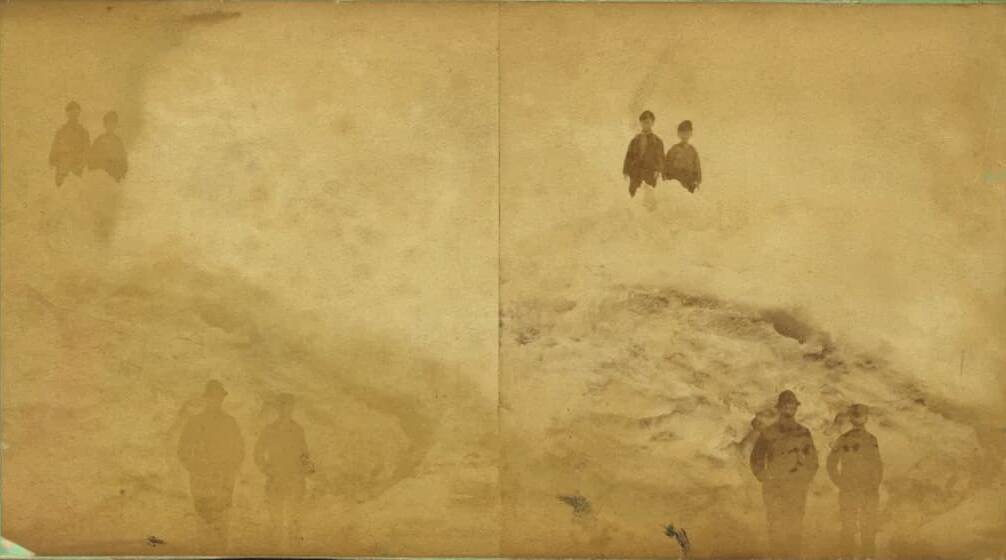
Image: “Ice bergs, Long Point”, a stereograph by G. H. Nickerson (George Hathaway), featuring unknown figures, latter 19th century.
- Carlos Rocha. La Vida y Obra de René Daumal . Vol I, pg 18, Ed Monte Ávila, 2006. ↩︎
- Carlos Rocha. La Vida y Obra de René Daumal . Vol I. pg 70 y 71. Ed Monte Ávila, 2006. ↩︎
- Carlos Rocha. La Vida y Obra de René Daumal . Vol I, pg 13, Ed Monte Ávila, 2006. ↩︎
- Carlos Rocha. La Vida y Obra de René Daumal . Vol I, pg 139, Ed Monte Ávila, 2006. ↩︎
- Daumal, Landes-Levi, Landes-Levi, Louise, and Longhouse. Memorables / René Daumal ; Translated by Louise Landes Levi. Green River, Vt.: Longhouse, 2009. ↩︎