The conversations that gave substance and life to the book The Real Remains Invisible: Conversations with Olivier Laignel de Salzmann took place between 2003 and 2004 in Buenos Aires, Argentina. The book was published in 2005 in Colombia and was first made available to the members of the Teaching groups in Buenos Aires while Olivier Laignel de Salzmann was still alive.
This book bears direct, simple, and practical witness to the basic processes we experience in the evolution of consciousness as we delve into the discovery of our inner world, from the perspective of Mr. Gurdjieff’s Teaching.
Olivier was introduced to this Teaching, also known as the Fourth Way, as a child, since Mrs. Jeanne de Salzmann—his grandmother—took the lead in regrouping the students upon Mr. Gurdjieff’s death and later established the International Foundation that brings them together. Also, his mother—Mrs. Natalie de Salzmann de Etievan—received Mr. Gurdjieff’s teachings from childhood. Angela Laignel (Anga), Olivier’s wife and daughter of Mrs. Margaret Flinsch (Peggy)—another American student of George I. Gurdjieff who studied with him from the age of 19 until her death at 103, and who also founded the Teaching groups in New York, United States—also participates in the conversations.
The book was translated into English by Gabriela Ansari—the daughter of Olivier and Anga—under the title *In the Moment: Conversations with Olivier Laignel de Salzmann on the Teachings of G. I. Gurdjieff*, and as she notes in her publication, “this book is primarily intended for those who are already engaged in the Gurdjieff Work and familiar with the ideas. It could also be of interest to those who are merely seeking and curious about the Teachings of G. I. Gurdjieff.”
Note on the tenth anniversary of the reissue de Lo real permanece invisible
Gladys Jimeno Santoyo
Bogotá, October 17, 2025

Gladys Jimeno: What is illusion and reality?
Olivier Laignel: There are different versions of what reality is. People think that there is only one reality that exists, independent of the observers, and they believe that the purpose of observing is to discover what reality is. And what would that reality be when no one is observing? Any observation changes what is being observed, it modifies it, so there is no independent reality, there isn’t one, and that is the hardest thing to understand. Man builds his own realities.
Gladys: And each one builds it differently.
Olivier: Yes. And civilization builds a view of the world, a view of the Universe, which is said to be reality. In our era, scientific reality is accepted by the majority as the reality. For me, no. The magical world, which is denigrated by science, is for me just as real as scientific truth or reality. Reality is what I wish it to be. Reality depends on the lens I am seeing through, on a certain conditioning, on a way of thinking, a way of feeling. Being able to get closer and see this well would be a powerful freeing factor – to realize that there is no such thing, there is no absolute reality. It does not exist.
Gladys: In the Schools of Knowledge, the illusory world in which we live is placed in contrast with a transcendental reality, which is what is considered real…
Olivier: The only reality is that there is no reality. The only reality is that there is potential. We are behind the veil of Indra, which in Hinduism represents all the illusions, and that is all. All that is manifest is there. Behind it lies the non-manifest, the source of everything. That is reality, but it has no form, it is pure potential, it can assume any shape, any shape one wishes.
Gladys: So the form is the illusion?
Olivier: Yes. Anything, once it is manifest, once it appears and acquires a form, can be appreciated by the senses, but it is no longer real, it no longer represents reality, it represents a facet of the veil of the God. The real, the living, is what lies behind it. Once it acquires a form it dies. It enters into the dance of cause and effect and repeats once again.
Gladys: The illusion would be the form…and the unreal?
Olivier: What ‘unreal’ are you referring to?
Gladys: Of total death, of non-life.
Olivier: People are dead in so far as they do not seek what lies beneath the forms, in so far as they cease to be interested by seeking. It’s not at all easy to access what lies behind what is manifest, but one looks for it. Scientists look for it in their way, they look for the cause of this, this and that, they always try to go further and they never really get to what lies behind.
Gladys: In that sense, we could say that ignorance and illusion are related on the one hand and knowledge and reality on the other. Knowing would be part of the first pairing.
Olivier: The one who knows more, the man with greater knowledge and understanding, can be distinguished because he becomes more humble as his understanding and knowledge grows, because he begins to realize how little can be known in front of the immensity of what is not accessible. This is true in all fields, including the field of spiritual search. A lot of knowledge is necessary to be able to truthfully say, “I don’t know,” and not only I don’t know but that the essential things, the most important of all, cannot be known. They are not accessible to us and never will be. In fact, it’s already most extraordinary that we, as human beings, are allowed to have as high of an access as we do. We have the possibility of going far beyond the form and that is no small thing. We can feel the nature of the Universe, feel one’s own Buddha nature, feel that we are a part of everything. There, there are no questions or interrogators; there is no need to know. It does not last, and one comes back.
All of the polemics of whether my interpretation of reality is more real than yours – it’s like the story of the three blind men and the elephant…fighting about what the elephant looks like from the point of view of feeling the part of the elephant that they are touching.
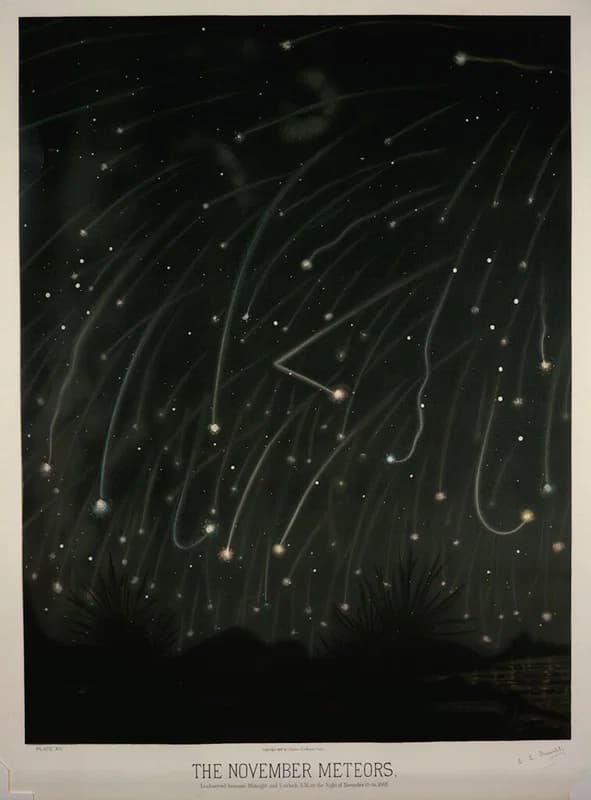
Image: The November Meteors – The Trouvelot Astronomical Drawings (1882).